
The underwriting process sits at the center of any insurance operation. It determines what risk gets accepted, on what terms, and at what price. When it runs well, carriers and MGAs move quickly, bind the business they want, and deliver competitive service to agents and brokers. When it runs on manual processes and disconnected tools, submission queues back up, underwriters spend time on administrative tasks instead of risk judgment, and decisions take longer than they should.
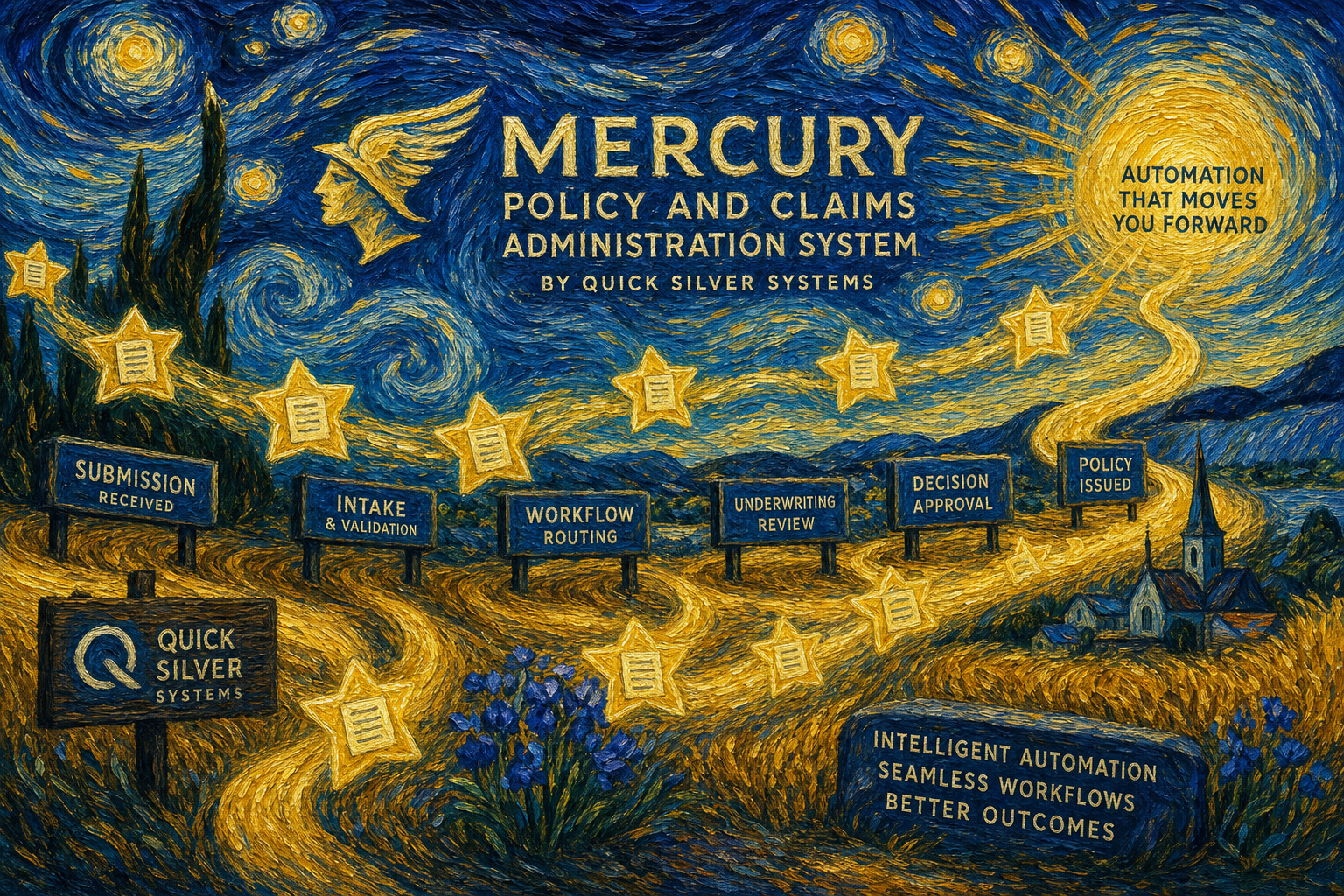
Mercury addresses this through configurable underwriting workflow automation — tools that let insurers define how submissions move through the system, what rules govern each step, and where human judgment is needed versus where the system can act autonomously.
Most underwriting inefficiency comes from one of three sources: routing ambiguity, rule inconsistency, and manual hand-offs. Routing ambiguity happens when a submission arrives and it is not clear which underwriter, queue, or team should handle it. Rule inconsistency happens when underwriters apply appetite and authority guidelines differently because those guidelines are not encoded in the system. Manual hand-offs happen when getting a submission from one stage to the next requires email, spreadsheets, or phone calls instead of system-driven action.
All three of these are workflow design problems, not underwriting judgment problems. The underwriters themselves may be skilled and decisive — but if the system surrounding them does not enforce routing, encode rules, or automate transitions, the process will be slower and more variable than it needs to be.
Mercury lets insurers configure underwriting workflows to match their actual appetite and operating model. Key capabilities include:
When underwriting workflow runs on configured rules rather than individual judgment calls about process, a few things change. Cycle times compress because submissions move through defined stages rather than waiting for manual routing decisions. Consistency improves because authority limits and appetite rules are applied the same way regardless of which underwriter or office is handling the file. And capacity scales better because straight-through processing handles the routine work, freeing underwriters for complex accounts.
For MGAs in particular, underwriting workflow automation matters because the MGA model depends on fast, consistent decisions. Binding authority programs require that submissions be handled quickly and within defined parameters — and Mercury's workflow tools are designed to support exactly that operating model.
Mercury's underwriting workflow capabilities are part of a broader platform architecture built for configurability. The same low-code tools that govern workflow routing also govern rating, form selection, and policy issuance — so insurers can align the entire new business process within a single system. As appetite changes, workflow rules can be updated to reflect the new parameters without rebuilding from scratch.
That configurability is what distinguishes a platform like Mercury from a fixed-logic system. Insurance operations change. Appetite shifts. Authority levels are recalibrated. A workflow automation system that requires vendor intervention to update those parameters creates a dependency that slows the business down. Mercury is designed to let carriers and MGAs own their workflow configuration and evolve it as the business requires.
If you want to see how Mercury's underwriting workflow automation could work for your operation, schedule a demo with Quick Silver Systems.


 Prior
Prior 