Insurance IT leaders inherit the hardest technology problem in financial services: run a 24/7 P&C platform that touches every regulator, every bank, every reinsurer, every agent, and every policyholder, on a legacy stack that was never designed for API-driven distribution, and keep it secure, audited, and available. Every vendor decision compounds for a decade.

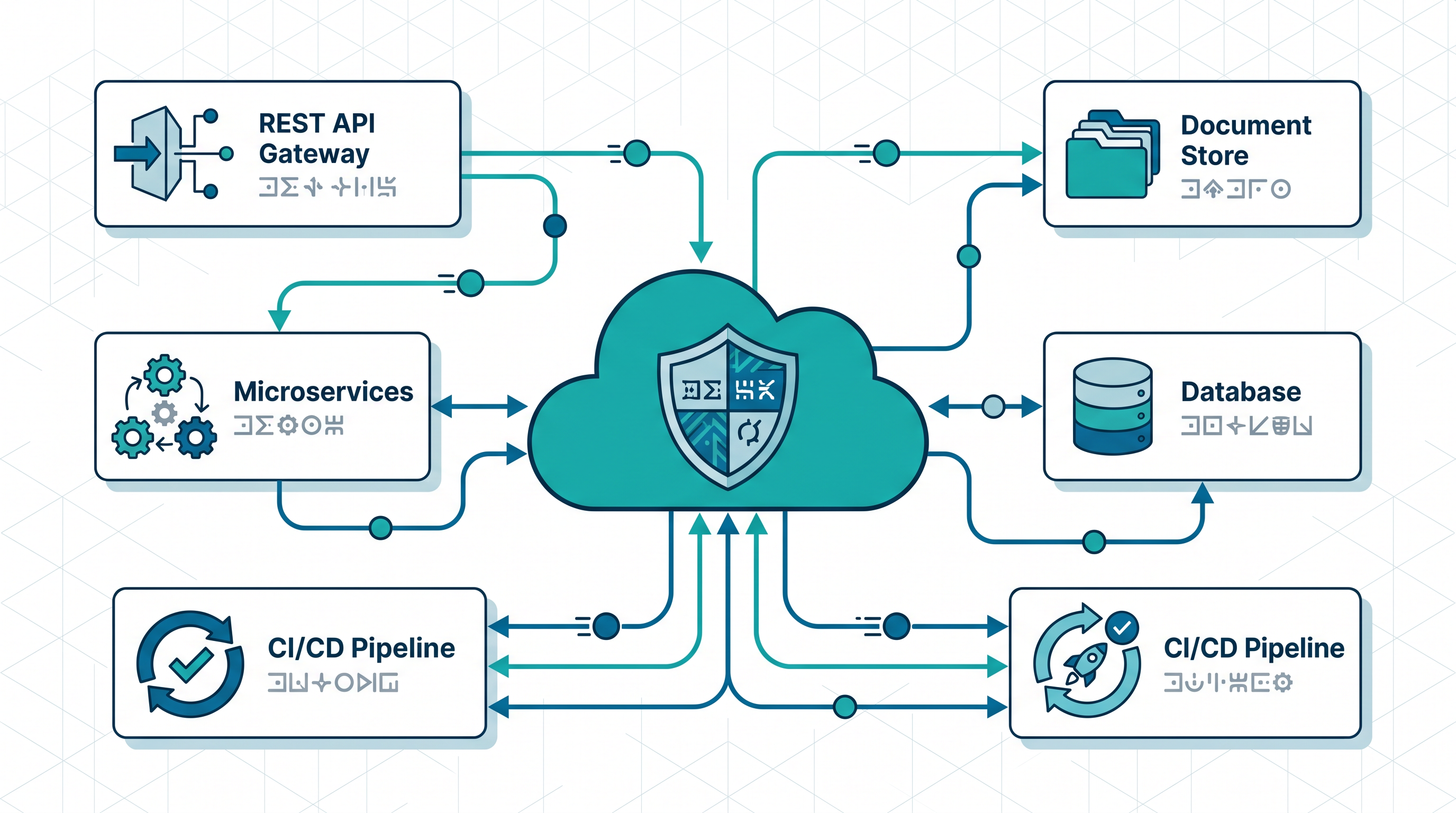
The Mercury Policy and Claims Administration System from Quick Silver Systems, Inc. is an API-first, AWS cloud-native, low-code-configurable P&C insurance platform built for information technology leaders who refuse to trade agility for stability. Below are the Mercury IT features that matter most to insurance CIOs, CTOs, enterprise architects, DevOps engineers, and information security leaders.

API‑first
Open integration model, REST & webhooks
AWS
Cloud‑native SaaS, multi-AZ, auto-scaling
Low‑code
Product & workflow configuration
CI/CD
Continuous integration & deployment pipeline
01
MercuryREST · webhooksGET /policyPOST /quotePOST /fnolGET /claimagent portalMVR · CLUEtelematicsBI warehouse
Feature 01

API-First Architecture and Open Integration Model

Mercury is API-first. Every business function - quote, bind, endorse, pay, FNOL, document retrieval, reporting - is accessible through documented REST APIs with consistent authentication, pagination, and error semantics. Third-party data services (MVR, CLUE, telematics, credit, catastrophe modeling) integrate as standard connectors rather than custom builds.

For an insurance CTO or enterprise architect, API-first is the architectural decision that pays back for a decade. New distribution channels, embedded insurance partnerships, and data science pipelines plug into Mercury without a forklift upgrade. The carrier becomes an integration hub instead of an integration liability.

Feature 02

AWS Cloud-Native SaaS with Predictable Uptime

Mercury runs as a cloud-native SaaS on Amazon Web Services (AWS) with managed infrastructure, horizontal scaling, automated backups, disaster recovery, and multi-region resilience. Carriers consume Mercury as a service - no data center refreshes, no capacity planning meetings, no midnight patching windows.

For an insurance CIO, moving core to AWS-managed SaaS reframes the IT cost and risk conversation. Uptime becomes a contractual SLA instead of an internal heroic effort, infrastructure spend becomes predictable, and the IT organization gets to spend its cycles on integration and business value instead of storage arrays and Windows patches.

02
AWS cloud-nativeus-east-1aactiveus-east-1bactiveus-east-1cactiveMulti-AZ · auto-scale · managed backupsFixed subscription, predictable uptime
03
Workflow designerSubmissionValidateRateReferApproveBindDrag, drop, save → live in production
Feature 03

Low-Code and No-Code Configuration for Products and Workflows

Mercury supports extensive low-code and no-code configuration - product definitions, rating tables, workflow rules, document templates, portal branding, and communication triggers are all configurable without source code changes. Business analysts and insurance product managers configure directly; engineering focuses on integration and extension.

This is the feature that lets an IT leader stop being the bottleneck for every state filing, every rate change, and every product variation. Engineering hours get spent on high-leverage integrations instead of rule changes. Time-to-market improves dramatically, and the IT organization finally gets to play offense.

Feature 04

Continuous Integration and Deployment Pipeline

Mercury is delivered through a modern continuous integration and continuous deployment (CI/CD) pipeline with automated testing, staged rollouts, feature flags, and fast rollback. Updates land in controlled waves with visibility into what changed, who tested it, and what the impact was.

Legacy insurance platforms ship major releases once or twice a year and turn every release into an all-hands weekend. Mercury CI/CD replaces that with continuous, tested, reversible change. For a DevOps leader, it means no more release-weekend war rooms and dramatically lower change risk across the carrier's technology surface.

04
CommitgitBuildCITestsuiteDeploystageProdCI / CD pipelineEvery change tested. Every release traceable.
05
HIPAA-alignedEncryption · Role-based · Audited
Feature 05

HIPAA-Aligned Security, Role-Based Access, and Encryption

Mercury ships with HIPAA-aligned security, encryption at rest and in transit, role-based access control, SSO, MFA, granular permissioning, and comprehensive audit logging. Information security teams get a defensible posture out of the box rather than a platform to harden over eighteen months.

For an insurance CISO, the perimeter is only as strong as the weakest core system. Mercury's security architecture is built for regulated financial and medical data from the beginning - which means faster SOC 2 evidence gathering, shorter penetration-test remediation cycles, and a stronger story to tell the board audit committee.

Feature 06

Unified Audit Trail and Observability

Every user action, every API call, every document access, every rating decision, and every accounting transaction in Mercury writes to a unified audit trail. Operational observability - platform health, error rates, queue depths, API latencies - is surfaced in dashboards accessible to the IT operations team.

Insurance IT leaders typically stitch audit evidence together from six systems when a regulator or auditor asks. Mercury collapses that into a single queryable surface, which saves the IT organization hundreds of hours per exam and gives the CIO a defensible answer to the hardest audit questions on the first ask.

06
Audit trail2026-04-21 09:14 policy #P-442019 bound2026-04-21 09:18 endorsement rate change2026-04-21 09:31 claim payment $14,2502026-04-21 09:47 document uploaded2026-04-21 10:02 rating rule v2026.04
P&C Insurance System Overlay

SCHEDULE A DEMO


